
Why Welsh Labour lost
Breaking down why Wales' governing party collapsed so dramatically

Below is a piece by Welsh academic Professor Richard Wyn Jones. He is the Director of Cardiff University’s Wales Governance Centre.
He has written extensively on what underpins Welsh Labour’s recent decline in Wales and has penned this guest article looking at the issue.
I hope you enjoy the piece. Additionally you can also watch this video from him and friend of the newsletter Dr Jac Larner where they breakdown details of the Senedd election results.
Welsh Labour and the end of hegemony
By Prof Richard Wyn Jones
On the 7th of May Wales experienced its first ‘change election’ in my lifetime. It was also the first change election in Wales during the lifetimes of my parents, born in 1937 and 1940 respectively. We can go even further: neither did my longest surviving grandparent – who was born in 1907 and died in 1999 – ever get the opportunity to vote in a change election in Wales as he was too young to vote in the 1922 general election. Yes, until a few weeks ago, that was the year of our most recent change election; the year when Labour began its still unbroken series of 28 consecutive general election victories in Wales!
I mention all this as one way of trying to convey the sheer novelty of what has just occurred. And of course, it’s not simply that has Labour has lost its first national election in Wales for over a century. Wales’ long-dominant party has just been utterly humiliated by its electorate.
By one of those cosmic coincidences, the Senedd election took place just over 60 years since the high-water mark of Labour’s electoral dominance in Wales. In the 1966 UK General Election the party secured over 60% of the popular vote across Wales, winning all bar 4 of the country’s 36 constituencies. In 2026 it won 11%. Thanks to a proportional voting system and the expansion of the Senedd from 60 to 96 members, that was enough to secure 9 seats. However, had a UK general election had been held in Wales on the 7th of May then – based on the Westminster Voting Intention figures polled in Wales in the same week – Labour would not have won a single seat. In fact, the party wouldn’t even have come close. How the mighty have fallen.
There are of course a lot of caveats that need to be entered here. I’m certainly not claiming that this will be Labour’s fate in Wales when the next UK general election is held. But, with Labour having finished in a poor third place after both Plaid Cymru (on 35%) and Reform UK (on 29%) in a national election featuring a turnout, at 52%, that was broadly comparable to the 56% that voted in 2024 UK general election in Wales, it is nonetheless clear that the era of one-party dominance of Welsh electoral politics has come to an end – and with it the end of Labour hegemony.
The concept of hegemony is associated with the work of the Sardinian Marxist, Antonio Gramsci. One of the people to introduce the ideas of Gramsci to the English-speaking world was the wonderfully charismatic Welsh historian Gwyn A. Williams. In a pioneering 1960 article Williams explained Gramsci’s concept of hegemony in the following terms:
a socio-political…order in which a certain way of life and thought is dominant, in which one concept of reality is diffused throughout society…informing with its spirit all taste, morality, customs, religious and political principles, and all social relations, particularly in their intellectual and moral connotation. (1)
A quarter of a century later, in what became his most celebrated book – the Gramsci-infused When was Wales? – Williams referred to Labour as being the hegemonic force in post-1922 Wales. He was right.
As if its feat in winning election after election for decade after decade was not enough, Labour was much more than Wales’s dominant political party in electoral terms. It parlayed its political leadership into cultural and even moral leadership in Wales. Labour values came to be regarded as synonymous with the very core of Welsh identity itself. Or in other words, Welsh Labour begat Labour Wales. This is why the end of Labour dominance is set to mean so much more than a very different colour scheme on the nation’s electoral map. It will inevitably entail a potentially radical revision of our very identity, our culture, our values, and therefore our sense of our place in the world.
In what follows I will explore the reasons for the collapse of Labour hegemony. Inevitably, any conclusions must remain tentative. Much of the history of the internal machinations within the Labour Party over recent years remains unwritten or at least unpublished. Moreover, while Jac Larner and other Cardiff University Wales Governance Centre colleagues have presented some initial analysis of the Senedd election result, there is also much more work to be done in this regard. (2) It is also inevitably the case that our perceptions of the significance of the 2026 Senedd election will continue to be shaped and reshaped by future developments in Welsh and UK politics, and particularly the future trajectory of the Labour Party in Wales. Nonetheless, even at this preliminary stage, it is useful to try to provide an accounting of this extraordinary moment in Welsh and wider UK politics, if only as a foil for the development of alternative analyses.
The analysis will be divided into three broad themes, namely:
Social change;
Government and the ‘cost of governing’; and
Ideology and policy.
It should be stressed, however, that all of these are interlinked in complex ways. They are treated separately here simply as an aid to clarity.
Social change
The Labour Party in Wales is suffering from the consequences of those same social changes that have afflicted every northern European centre-left party, be that in Germany, France, the Netherlands, Denmark, Norway, or elsewhere. Bolstered by the structuring effect of Westminster’s ‘first past the post’ electoral system on party competition, Labour may have been able to resist the impact of these negative effects for longer than most. But who can now doubt that a tipping point has been reached?
These social changes as well as their political impacts will be broadly familiar. Deindustrialisation leading to the decline of the ‘traditional’ working class and the de-coupling of left-wing beliefs from what remains of the labour movement. The rapid growth in the proportion of the workforce with a university degree shifting a large section of society in a decidedly socially liberal direction. As a result, we’ve seen the growth of the so-called Nordic Left parties as well as Green parties – parties that tend to stand to the left of and be more socially liberal than the traditionally dominant Social Democratic and Labour parties. We have also seen a fracturing on the opposite side of the political spectrum with traditional Conservative or Christian Democratic parties facing challenges from the populist right. The latter differ from their staid, ‘bourgeois’ competitors by being more socially conservative and even authoritarian, but also – often – by being less orthodox in terms of their adherence to right wing economic dogma.
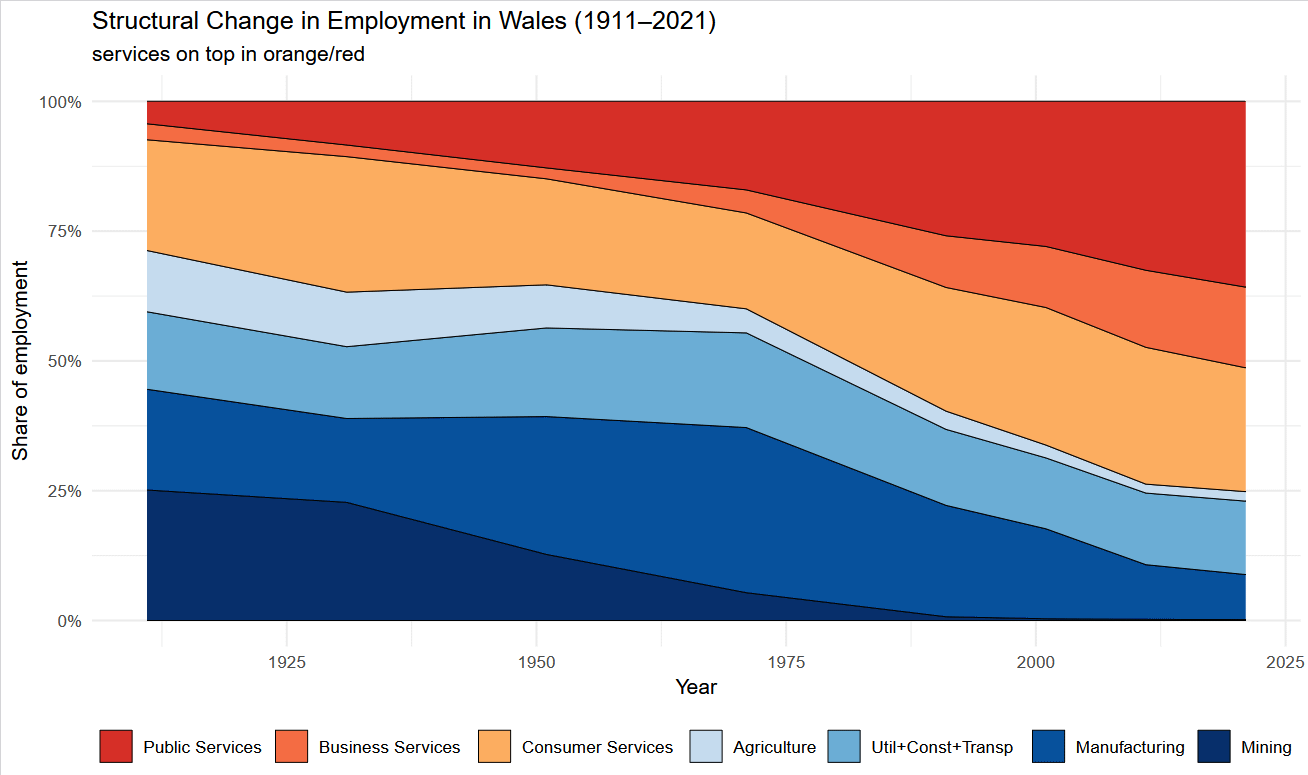
All this can readily be read across into the Welsh context. No one can be unaware that Wales is a country that has experienced a massive, deeply destructive process of economic restructuring that has fundamentally transformed patterns of employment and associated social structures (see Figure 1). I won’t seek to discuss these changes here, although – for the uninitiated – it is worth underlining that some of the most familiar cliches about Wales and Welsh society were once upon a time firmly based in socio-economic reality. In 1921, that is the year before our last but one change election, there were 270,000 colliers in Wales. With their families, they accounted for some four in every ten of the country’s population.
It is, however, worth pausing over a Wales-specific story of demographic change that has served to further undermine Labour support. For Welsh Labour was always more than a traditional centre left party drawing on the votes of the working class. Rather, the earliest political science forays into understanding voting behaviour in Wales were prompted by the realisation that, in Wales, Labour performed more strongly than the class profile of Welsh society would have led us to expect.
In the era of class voting, not only was Labour able to perform ever better among working class voters in Wales than was the case in the rest of Britain, but the party attracted a higher proportion of the middle class vote in Wales than elsewhere.
Subsequent research ended up attributing this ‘difference’ to the role of Welsh national identity both in priming voters to support Labour but also in acting to limit support for the Conservative party. (3) Indeed, the strongest version of the argument is that Welsh national identity has been constructed, in part at least, against the Tories – an argument that will be completely unsurprising to historians interested in late nineteenth and early twentieth century Wales.
How precisely to characterise Welsh Labour in its glory days is a moot point and one that has not really received the scholarly attention it deserved. The party’s support base straddled both class and nation. Although, it seems more apposite to suggest that was in turn a reflection of the way in which class and national narratives intertwine in Wales – doing so in ways familiar from the context of other stateless or formerly stateless nations across Europe. The impact of all this was arguably to make Welsh Labour a ‘catch all party’, to utilise the term popularised by Otto Kirchheimer back in the 1950s, with all the ideological hedging and ambiguity that characterises such parties. In this sense, whatever its self-image, there’s a plausible argument that Welsh Labour was always more akin to Ireland’s Fianna Fáil than Sweden’s Social Democrats.
This matters for at least three reasons. First, there does not seem to be the same taboo on voting for Reform and its predecessor parties among those with a dual Welsh-British identity as remains the case for voting for the Conservatives. Thus, the replacement of the latter by the former is especially challenging for Labour who can no-longer rely on Welsh anti-Tory inoculation to protect its right flank.
Second and more generally, as a result of two inter-related developments, Wales is becoming less British.
Younger people, in particular, are less likely to identify as British, tending rather to identify as exclusively Welsh. This phenomenon has long been observed in Scotland and has been attributed to the break-down of the British ‘welfare state nationalism’ that characterised the immediate post-Second World War period. The same phenomenon is observable in Wales too, and the same explanation appears plausible.
More proximately, Brexit has had a further destabilising influence on British national identity in Wales. In the wake of the 2016 referendum result, Remainers who had previously identified as Welsh and British have abandoned a British identity while those Remainers who identified as British or British and English appear to be eschewing any sense of strong national identity.
Third and finally, not only are social and economic values in Wales closely aligned to patterns of national identity, but those differences have become more polarised in the decade since the Brexit referendum (as illustrated in Figure 2). Thus, by now, those who feel Welsh but not British are significantly more left wing and socially liberal than those who feel both Welsh and British. They also tend to have rather different views of the polity, with the exclusively Welsh now tending to be very supportive of levels of home rule extending to full independence as well as being profoundly pro-European.
Figure 2: National Identities and Social and Economic Values in Wales, 2016-2026
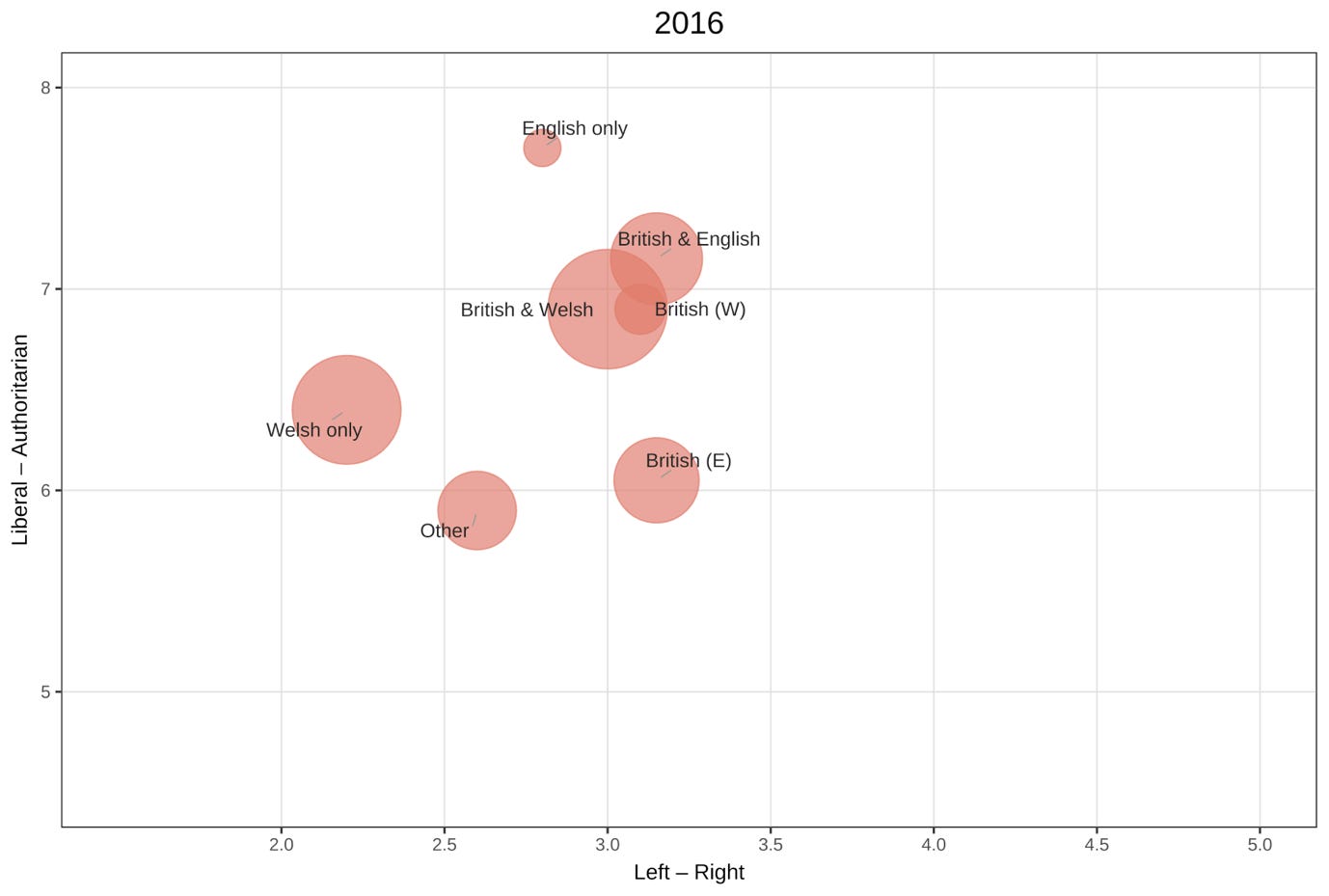
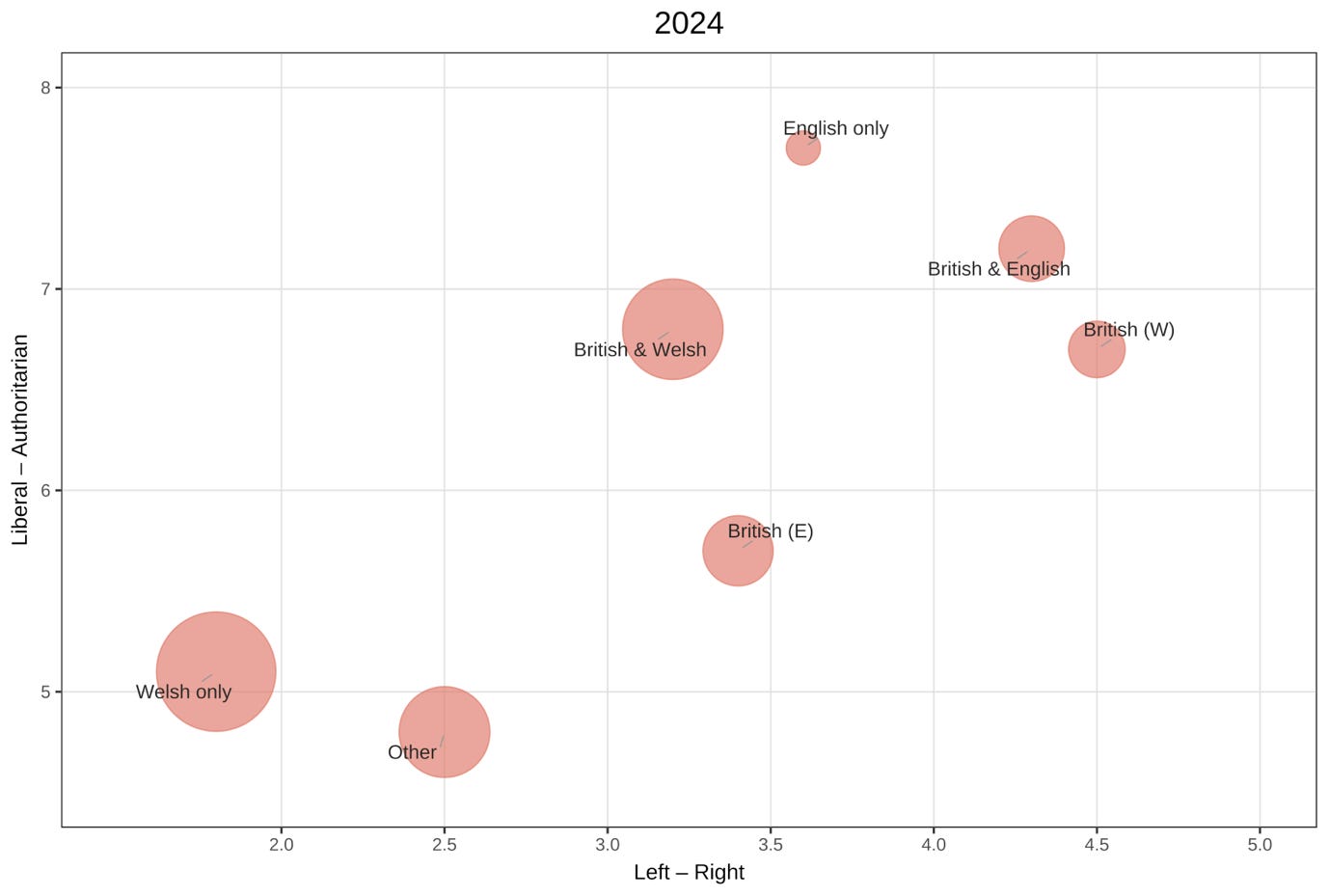
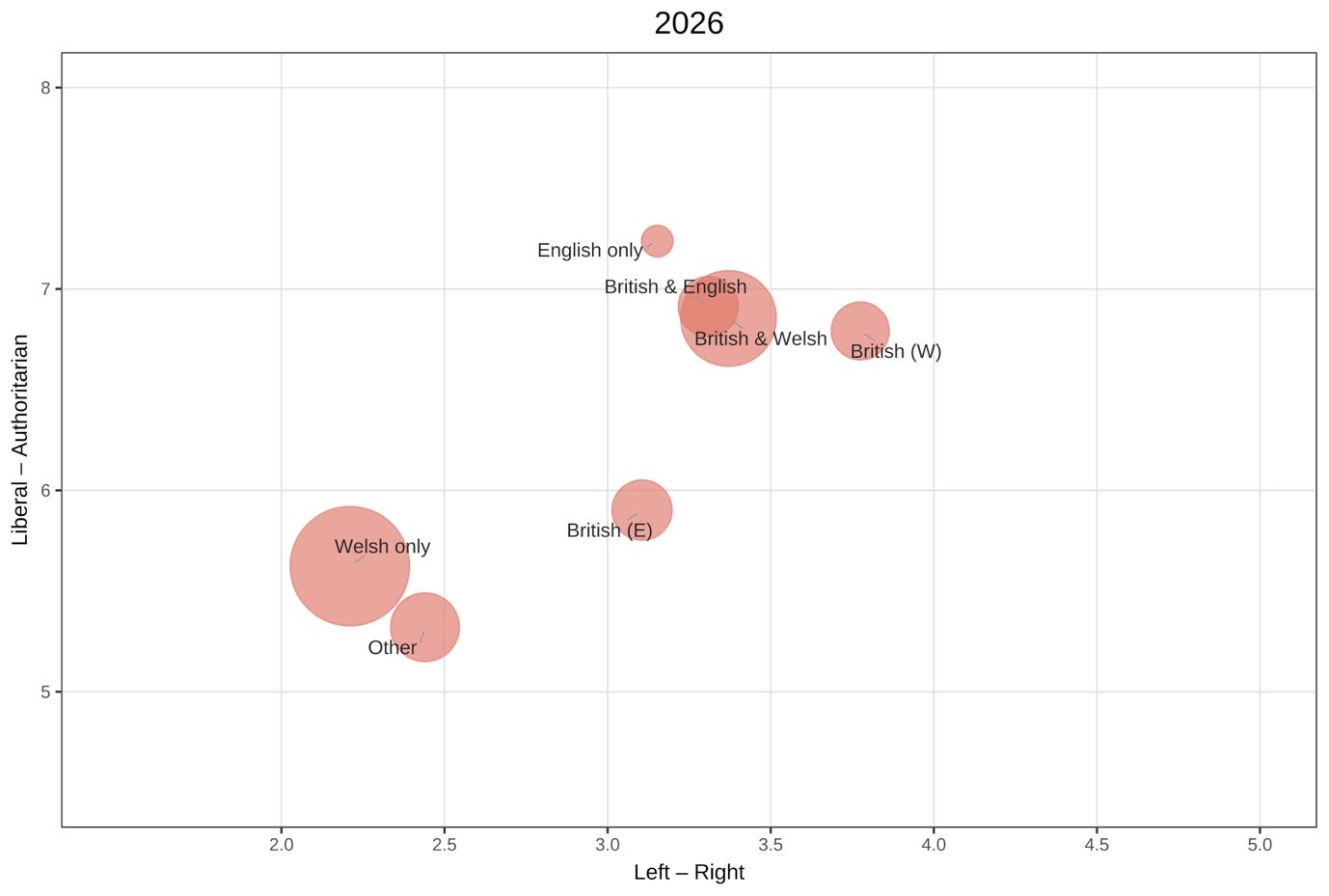
Looking to the party’s progressive flank, the combination of developments two and three – Wales becoming less British and the polarisation of economic and social values, as well as constitutional attitudes associated with national identity – have had very serious implications for Labour. If the core elements of Labour’s electoral coalition was previously a combination of those who identified as Welsh only, those who identified as Welsh and British, and those people born in England living in Wales who identify as British only, then not only has the relative size of those groups changed, but they are also increasingly distant from each other in ideological terms. In such a context, ‘catching-all’ would appear to be nigh on impossible.
Government and the ‘cost of governing’
In political science terms, Welsh Labour has paid the ‘cost of governing’. It has long been recognised that the longer any party is in power, the more likely it is to disappoint some section or other of its erstwhile supporter base. All things being equal, therefore, governing parties can therefore be expected to lose support over time. Given that Labour was in power at the devolved level in Wales for 27 years, it should therefore come as no surprise it ended up becoming very unpopular. This is especially the case in a context in which few would regard Welsh Government’s record as being particularly distinguished.
As if this were not enough it itself, Labour’s standing in Wales was further diminished by the existence of a very, very unpopular Labour Government in power at the UK level, led by a Prime Minister in Sir Keir Starmer whose polling figures are the worst ever recorded for a Prime Minister in Wales. The result is that Labour in Wales has been caught in an incumbency ‘double whammy’ of frightening proportions. In recent years, Labour’s preferred slogan in Wales has been ‘two governments working in harmony’. In reality, it’s been two governments working not particularly harmoniously, both of which have managed to thoroughly alienate Labour’s electoral base.
Yet, attributing Welsh Labour’s current travails to the inevitable workings of political gravity – what goes up must come down, so to speak – seems insufficient. After all, in May 2023, at 36%, Labour was polling exactly twice the number then being projected for Plaid Cymru (18%). A year later, Labour was still polling 30% of the vote – just under 3 times its final Senedd total. Labour’s decline does not, therefore, reflect the outworkings of some kind of gradual process of creeping disillusionment. It rather appears to have been a far more precipitate decline than that: a collapse rather than a slow slide. There is more to explain. The following points may help us explain the puzzle.
Blame shifting. When the Conservatives were in power at the UK level between 2010 and 2024, Welsh Labour were adept at ‘blame-shifting’. Policy failures in Wales were attributed to the Tory government in London. We might suggest that this is a view that large parts of the traditionally anti-Conservative Welsh electorate were pre-disposed to accept. Certainly, survey evidence from this period suggests that large parts of the Welsh electorate – especially those who identify as Welsh – tended to blame ‘London’ for poor outcomes in areas of devolved responsibility. The same voters were even willing to credit the Welsh Government for what they perceived as positive policy outcomes in areas that did not fall under its responsibility. While not a great situation for those who of us who care about democratic accountability, it was about as good as it gets if you were a member of the then Welsh Government! But of course, blame shifting became substantially trickier after the formation of a UK Labour Government – especially in a context in which Welsh Labour has become deeply reluctant to differentiate the Welsh and UK Labour identities (a point to which I return below.)
Covid. It has become a truism to point out that every government in every developed country that led its population through the Covid pandemic has subsequently suffered a serious loss of popularity. Welsh Labour is certainly no exception from this more general pattern. Work by my Cardiff colleague Stephen Cushion also suggests that the experience of Covid pandemic served to give the Welsh population a crash course in the extent of devolved powers and responsibilities – something about which knowledge was, until the pandemic, notably vague. As such, Covid may well have served to render ‘blame shifting’ a far more difficult endeavour than had previously been the case.
Blame shifting as ‘expectation generation’. Welsh Labour blame shifting was also, inevitably, an exercise in what we might term ‘expectation generation’. The Welsh electorate were told not only that it was the UK Conservative Government’s fault that outcomes in Welsh public services were not what they might wish for – because of Conservative austerity, because of an unfair funding mechanism, and the rest. More than that, both implicitly and explicitly, they were led to believe that the election of a Labour government at the UK level would have a transformative effect in Wales; and not only on the ability of the Welsh Government to deliver but also on its general status and standing, which had been under attack, especially after the formation of Johnson administration in 2019.
But while this may have been the view of leading figures in the Welsh Government, this was clearly not the view of the Welsh Parliamentary Labour Party or the new UK Government itself. Thus, the expectations generated over those 14 long years of Conservative rule have been dashed. Not only has there been vanishingly little ‘pork’ in evidence – to use the parlance of US politics – but even obvious injustices / anomalies have not been addressed, with rail infrastructure spending providing the paradigmatic example. Moreover, far from objecting to this treatment, the Westminster-based faction of the Welsh Labour party would appear to be actively revelling in it, even though – in terms of rational electoral calculation – it would appear to damage their own future election prospects. To understand this, we turn finally to ideology and policy.
Ideology and policy
The end of Labour hegemony has coinciding with the collapse of the ‘Welsh Labour’ project, by which I mean the attempt to portray the party in Wales as embodying distinctively Welsh views and values; a project which we associate with First Ministers Rhodri Morgan, Carwyn Jones and Mark Drakeford.
It has long been recognised that parties prosper at the substate level by portraying themselves and the champions of the region, rather than the tribunes of the centre. This was exactly the approach crystalised in the Welsh Labour slogan ‘standing up for Wales’ and it proved an extremely successful one. Public attitudes data suggest that voters in Wales did indeed differentiate between British and Welsh Labour and were more positively disposed towards the latter than the former. Moreover, this was more than a winning formula at the devolved level only. There is also evidence that it proved helpful in electoral terms at the Westminster level: consider, for example, the prominence afforded to Carwyn Jones in Labour’s campaign in Wales at the time of the 2017 UK general election.
Yet, when in December 2023 Mark Drakeford announced his intention to stand aside as First Minister, it soon became clear how shallow the wider party’s commitment to this project really was. Vaughan Gething was narrowly elected as successor in March 2024. He was the least ‘Welsh Labour’ aligned of the two candidates on offer. Relatedly, he was also the choice of the party establishment including an overwhelming majority of the Welsh PLP. Gething’s victory was overshadowed by his willingness to accept a (in Welsh terms) very large and hugely contentious donation to fund his campaign. The ensuing controversy was such as to force his resignation soon after the UK general election in July of the same year. He was succeeded in short order by Eluned Morgan, a Gething supporter whose cabinet was in turn dominated other Gething supporters. This was a continuity Gething government. Morgan followed her immediate predecessor’s lead by rolling back on previous attempts to differentiate the Welsh from the UK Labour brands. Welsh and UK Labour were separated only by geography rather than by values and outlook. Rather than distinctiveness, it was – after all – fundamental harmony that characterised the relationship between them. (4)
In short, ‘Welsh Labour’ capsized with remarkable rapidity. The failure of those leaders who were its champions to embed their project in the party’s structures meant that its demise went largely unresisted. Indeed, it was accompanied by a chorus of remarkably virulent anonymous press briefings by members of the Welsh PLP strongly implying that it was high time that their Senedd Labour group colleagues learn to recognise their proper place, namely as the junior partner within the party in Wales. (5)
Old-fashioned Labourism had reasserted itself. Westminster-centric, top-down, centralising: by early 2025, the Welsh Labour Party bore little resemblance to the party that had won the 2021 devolved election so handily. While increasingly calamitous polling numbers would encourage Eluned Morgan to return to the differentiation strategy (‘the red Welsh way’) in order to try to stem the tide, this was never more than half-hearted. It also seems to have been almost entirely ineffective.
Given that for more than a quarter of a century, the ‘Welsh Labour’ project was widely regarded as being synonymous with the Labour Party in Wales – its essence rather than a ‘project’ within it – its precipitous collapse surely demands a retrospective reconsideration. It is beyond the scope of this discussion to provide such an accounting. Even so, the following seems clear. ‘Welsh Labour’ was always more of a mood or vibe than a distinctive policy platform: a rhetorical focus on differentiation combined with soft Welsh nationalist messaging.
There is, however, at least one policy area in which this characterisation is insufficient. In its thinking about the UK’s territorial constitution, and specifically on how to balance the competing demands of autonomy and unity in the context the post-devolution union state, Welsh Labour was genuinely creative. Its efforts ranged from rethinking the UK state’s conceptualisation of sovereignty to drafting ‘oven ready’ legislation that would underpin what it regarded as a stable devolution dispensation for Wales.
At various points, elements of this agenda appeared poised to secure wider party support. Thus, Labour’s 2017 UK general election manifesto committed the party to legislating the Welsh Government’s Alternative Wales Bill onto the UK statute book. Similarly, Sir Keir Starmer’s embrace of ‘radical federalism’ at the time of his campaign to become Labour leader in 2020 seemed to chime with the characteristic Welsh Labour embrace of shared as opposed to parliamentary sovereignty. But such moments were fleeting. The UK party’s commitment to far-reaching changes to the Welsh devolution settlement was abandoned by the time of the 2019 general election, while Starmer’s interest in ‘radical federalism’ appears to have evaporated as soon as his victory was secured.
Lingering hopes that an incoming Labour government would introduce meaningful changes to the devolution arrangements for Wales were dashed on publication of the final report of Labour’s Commission on the Future of the UK in 2022, which made abundantly clear that the Welsh PLP’s influence on the party’s internal deliberations trumped that of the Labour Government in Cardiff.
Beyond the constitutional realm, however, Welsh Labour engaged in very little by way of creative policy development. Rather, devolution evolved as a largely ‘defensive’ approach to social and economic policy. In the context of the Blair and Brown administrations that accompanied the first decade of devolved government, the Welsh Government sought to mitigate what many in the party regarded as the excesses of ‘New Labour’, for example the quasi-marketisation of public service delivery and the use of the Private Finance Initiative to fund new public infrastructure.
During the period between 2010 and 2016, the focus was on defending public services in Wales from the negative effects of the austerity programme pursued by the subsequent Conservative-Liberal Democrat and Conservative administrations. Following the 2016 referendum, much effort was expended on trying to defend Wales from the inevitable damage that would be caused by a so-called ‘hard Brexit’ given the nature of the Welsh economy and the country’s reliance on EU structural funding. Throughout, it was always easier to define the Welsh Government by what it was against rather what it was for.
It can be argued that such an outcome was always over-determined. The initial powers of the then National Assembly were extremely limited, a situation which persisted until 2011. Even after a positive vote in another referendum led to the unlocking of more extensive legislative powers, the Welsh devolution dispensation has remained significantly weaker than Scotland’s because justice functions are reserved to London acting in this case in an ‘England and Wales’ capacity.
Yet, while constitutional constraints may well have played a role in limiting the ambitions of successive Labour governments, the party’s internal culture also played a significant contributory role. A structural effect of one-party domination has been to stifle intellectual creativity within Wales’s dominant party. Moreover, recalling that one of the characteristics of ‘catch all’ parties is the wide range of different ideological positions found within them, to the extent that this label is applicable to Welsh Labour, then it is no surprise that maintaining the party’s dominant position for its own sake has been one of the few common denominator positions within it. Notwithstanding ritualistic references to Aneurin Bevan, Labour in Wales has long prided itself on its self-styled ‘pragmatism’.
Yet even if it was only in the area of the so-called territorial constitution that the ‘Welsh Labour’ project developed genuine programmatic substance, the project’s collapse over the course of 2024 was nonetheless damaging to the party’s electoral prospects. This is not because constitutional issues have high salience in themselves – although it would be a mistake to overlook the existence of a pervasive sense that Wales is not treated ‘fairly’ within the UK.
Rather, the characteristic ‘Welsh Labour’ stress on the distinctiveness of the Labour Party in Wales allowed the party to appear simultaneously both pro-union and proudly soft-nationalist in orientation. This strategic ambiguity on the ‘national question’ assisted Labour in maintaining an electoral coalition that straddled the complex terrain of national identities in Wales in a way that no other party was able to match.
In ceasing to compete for voters on the Welsh side of the country’s identity spectrum at the same as Reform UK was consolidating support among voters in Wales who prioritise their British identity, Labour undermined its own electoral base. Given the height from which Labour has now fallen, it is hard to think of many comparable acts of self-harm in recent political history.
You can follow Prof Wyn Jones on Bluesky here.
© 2026 Throstle Worde Media ltd.
Throstle Worde Media ltd. Severn House, Hazell Drive, Newport, South Wales, Newport, NP10 8FY. Company No. 15984234
(1) Gwyn A. Williams, ‘The Concept of ‘Egemonia’ in Thought of Antonio Gramsci: Some notes on interpretation, Journal of the History of Ideas 21(4) (1960), p. 587.
(2) ‘The 2026 Senedd Election: What happened and why?’
(3) For anyone interested in this story see https://www.cymmrodorion.org/talk/nations-class-and-values-nationalisms-in-welsh-politics/
(4) It’s worth noting that Eluned Morgan never appears to have been particularly comfortable with Welsh Labour differentiation. In 2007 she was one of the first Labour politicians in Wales to call publicly for an end to Rhodri Morgan’s ‘clear red water’ strategy (http://news.bbc.co.uk/1/hi/wales/7011770.stm). She repeated the call in 2018 (https://www.itv.com/news/wales/2018-10-01/eluned-morgan-labour-leadership-red-water-corbyn)
(5) Dan Bloom, ‘Nigel Farage is surging in Britain’s rust belt – and Labour is panicked,’ Politico 25.2.2025 (https://www.politico.eu/article/nigel-farage-labour-rust-belt-britain-reform-uk-steelworks-retire/)
“Beyond the constitutional realm, however, Welsh Labour engaged in very little by way of creative policy development”